01
Capture your thoughts.
Add questions, ideas, hypotheses, and conclusions. Each is a typed node with a role in the reasoning, so your map is structure, not a pile of notes.
 Dare to conclude
Arguma is a visual tool for thinking through hard questions. Put your ideas, evidence, and assumptions on a canvas, link what supports or contradicts what, and when an assumption turns out wrong, see exactly which conclusions break with it.
Capture questions, problems, ideas, hypotheses, and conclusions as typed nodes. Then connect them with relations that show what supports, contradicts, explains, or depends on what.
Add questions, ideas, hypotheses, and conclusions. Each is a typed node with a role in the reasoning, so your map is structure, not a pile of notes.
Link them with typed relations: supports, contradicts, leads to. Each connection states how one thought bears on another, so the logic stays explicit.
Mark a hypothesis in research, confirmed, or falsified. When one is falsified, Arguma flags every conclusion built on it, so a broken assumption can't quietly stay true.
Arguma is the only mapping tool where marking a hypothesis as falsified automatically flags every conclusion that depended on it.
From the demo map: the red node is a falsified hypothesis. The conclusions below were built on it, and now they need another look.
The world is drowning in confident noise.
Feeds, media, and AI tools hand out ready-made conclusions that sound right before they've been checked, and it's easy to adopt them as your own. Arguma was built as the antidote: a place to slow down, lay your reasoning out where you can see it, and keep only the conclusions that survive.
Don't inherit certainty. Build it.
Separate maps for separate questions, one search across all of them, and exports that leave with you. Real screens from the app.
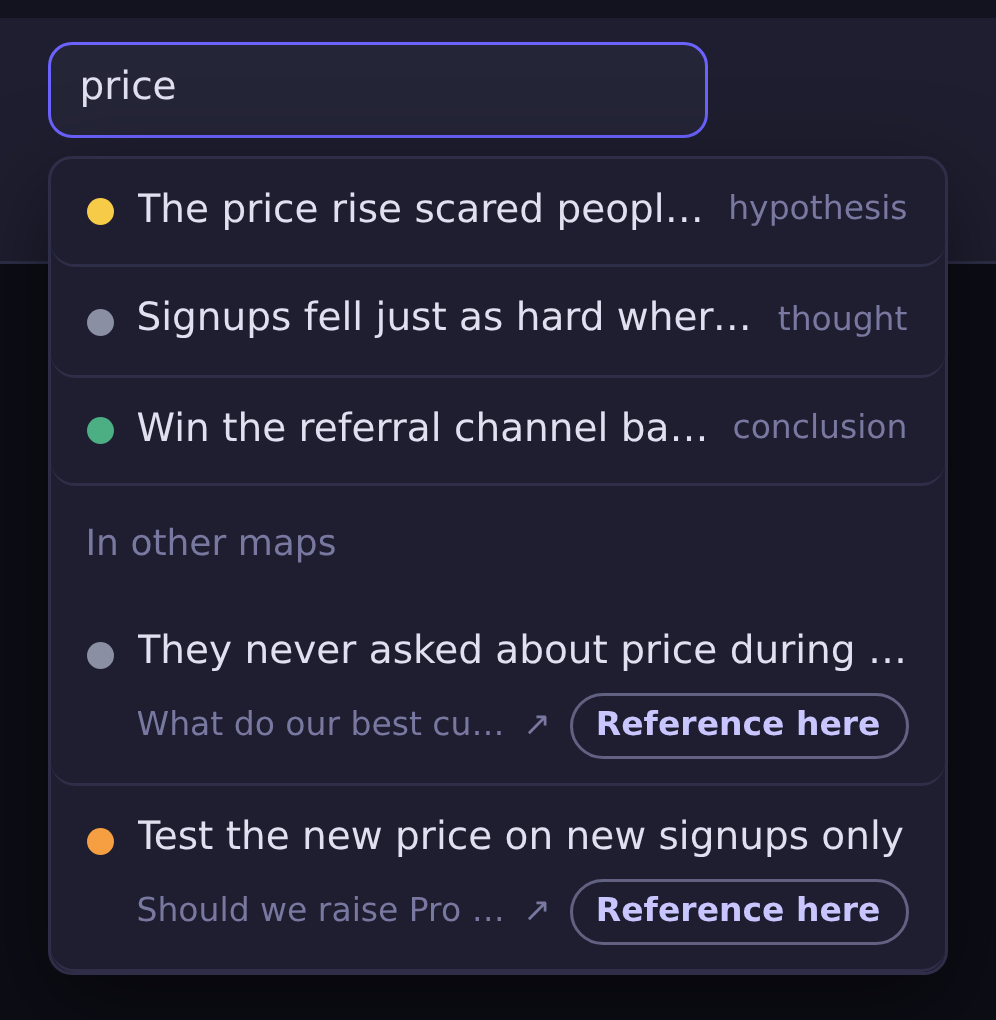
Keep a startup decision, a research problem and a personal choice on separate maps. One search still reaches all of them: type a word and every hypothesis, thought and conclusion that mentions it shows up, with the map it lives on.
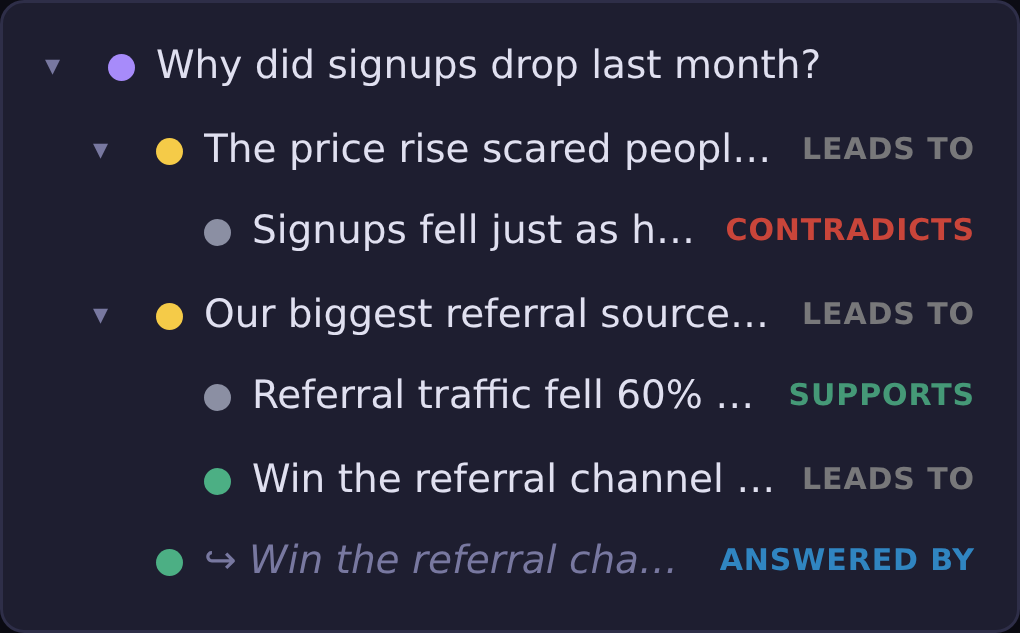
The canvas shows the shape of your reasoning. The outline lets you read it: any map becomes an indented tree that follows the links, and every row says how it bears on the one above.
Take any map out as the full JSON, a Markdown outline you can paste anywhere, a PNG of the canvas, or an Obsidian vault with one note per thought. Bring an Obsidian vault in the other way.
# Why did signups drop last month?

## Our biggest referral source went quiet
_hypothesis · status: confirmed_

- → **leads to**: Win the referral channel back before touching price

## Signups fell just as hard where the price never changed
_thought_

- → **contradicts**: The price rise scared people off

## Referral traffic fell 60% the same week
_thought_

- → **supports**: Our biggest referral source went quiet
Tag thoughts across maps with your own themes, and show one label at a time.
Show only some types, or only what still needs attention, like untested hypotheses.
Light up every route from a question or a problem down to the conclusions it reaches.
A quiet place to write: one thought at a time, full width, no canvas.
Arrange a messy map in one click. Ctrl Z puts it back.
Send a read-only link to a map or a single chain. Readers need no account.
Arguma is for work where casual certainty is expensive: strategy, research, writing, investing, product decisions, and any question where the reasoning matters.
Separate customer evidence from founder intuition. See which decisions depend on untested assumptions before you bet the roadmap on them.
“Why did signups drop last month?”
Open this map in the sandboxOrganize questions, evidence, open assumptions, falsified paths, and the confidence behind your current conclusions.
“Does spaced practice beat cramming?”
Open this map in the sandboxTurn scattered notes into claims you can inspect. Keep the elegant sentence only after the reasoning underneath survives.
Start from the claim your draft depends on
Open a blank map in the sandboxNo. Mind maps connect ideas by association; Arguma maps reasoning. Every node has a type (question, idea, hypothesis, conclusion), and every link states how one thought bears on another: supports, contradicts, answers, derives from. A mind map can't tell you which of your conclusions just broke. Arguma can.
No. Arguma is a personal reasoning workspace for mapping your own decisions, research questions, and beliefs. You can share a map read-only, but it is built for thinking things through, not for arguing with an audience.
Classic argument maps weigh pro and contra around a fixed thesis. Arguma models the whole reasoning process: open questions, competing hypotheses with verdicts and confidence, and conclusions whose dependencies are tracked. Arguma is the only mapping tool where marking a hypothesis as falsified automatically flags every conclusion that depended on it.
Obsidian is a knowledge base: notes linked by association, where the graph shows what mentions what: the links carry no meaning and nothing checks them. In Arguma the graph is the point: every link is a claim (supports, contradicts, answers, derives from), hypotheses carry verdicts, and falsifying one flags every conclusion that depended on it. Many people use both: import your vault to start from the notes you already have, reason in Arguma, archive back in Obsidian via Markdown export.
Yes, and it is where Arguma fits most naturally. Research already runs on competing hypotheses, evidence for and against, and verdicts that change as results come in, which is exactly the structure Arguma holds. Put the research question at the top, hang rival hypotheses off it, attach each piece of evidence as supporting or contradicting, and mark hypotheses in research, confirmed, or falsified as the work moves. When a result overturns a hypothesis, every conclusion resting on it is flagged for another look. Markdown export and Obsidian import mean it sits alongside the notes you already keep.
Free gives you 5 maps and the whole reasoning workflow, no card required. Plus is $6 a month or $48 a year for unlimited maps and the Plus features. See pricing.
Start with one map: a decision, a research question, a strategy, or a belief you keep repeating without checking. Put the reasoning where you can see it.