Belief history
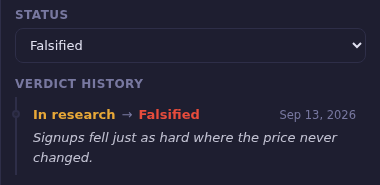
Every time you change a hypothesis from in research to confirmed or falsified,
Arguma records it, along with the reason you wrote at the time. Each hypothesis carries a timeline of
its verdicts, so you can see not only what you believe, but how you got there. When you share a chain,
readers see that timeline too.
Free accounts still get their changes recorded. Plus shows the record.
Fragility report
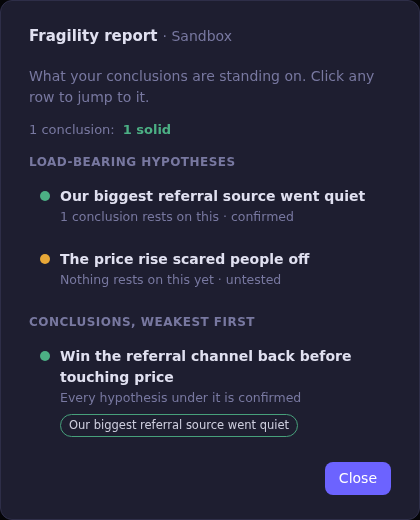
One click ranks every hypothesis in a map by how many conclusions rest on it, and lists your
conclusions weakest first: the ones standing on a falsified hypothesis, the ones standing on an
untested one, and the ones nothing supports at all. It follows the links all the way down, so a
conclusion three steps away from a broken assumption still shows up.
The count measures influence, not doubt: a hypothesis with many conclusions on it is
the one worth checking first, not the one most likely to be wrong.
Snapshots
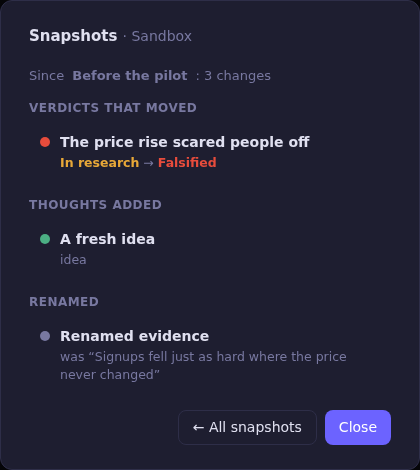
Freeze a map at a moment that matters: before the pilot, before the interview, before the results
came in. Later, ask what changed since. Arguma lists the verdicts that moved, the thoughts you added
or removed, the links you drew, and the conclusions whose confidence changed. Up to thirty per map.
Cross-map references
Maps are walls on purpose: a link can't cross them. A reference is the one exception. Pin a thought
from another map into this one and it shows that map's title and verdict, live. When the hypothesis
is falsified over there, every conclusion resting on it here is flagged. A belief you settled once
becomes evidence everywhere you use it, without copying it.
Templates
Start a new map from a structure instead of a blank canvas. Three come built in: a post-mortem, a
decision between options, and a literature review. Save any map of your own as a template, and the
titles, guidance and links carry over while the verdicts start fresh.
Share pages
Sharing stays free. Plus turns a share link into a page you can send to a client or a committee:
a readable address like arguma.io/c/why-signups-dropped, a description under the title,
an optional password, an expiry date, and no sign-up prompt, so it reads as your document.
Unlimited maps
Free gives you five. Plus removes the count, so a new question never has to wait for an old one
to be deleted. Every map keeps its own structure; labels and search still work across all of them.
A price that stays put
Whatever Plus costs when you subscribe is what it costs you for as long as you keep it. Later
increases apply to new subscribers, not to you. And if Plus is not what you expected, write within
fourteen days and you get a full refund.